 Apparel Boxes
 Corrugated Boxes
 Display Boxes
 Hemp Boxes
 Pillow Boxes
 Seasonal Boxes
 Bakery Boxes
 Cigarette Boxes
 Food Boxes
 Jewellry Boxes
 Rigid Boxes
 Toy Boxes
 Cardboard Boxes
 Candle Boxes
 Gift Boxes
 Kraft Boxes
 Retail Boxes
 Vape Boxes
 CBD Boxes
 Die Cut Boxes
 Hair Extension Boxes
 Mailer Boxes
 Soap Boxes
 Window Boxes
 Cosmetic Boxes
 Labels Stickers
 Mylar Bags
 Insert Boxes
 Gable Boxes
 Foldable Boxes
 Tuck Boxes
 Sleeve Boxes
Exploring The Different Types Of Stretch Film
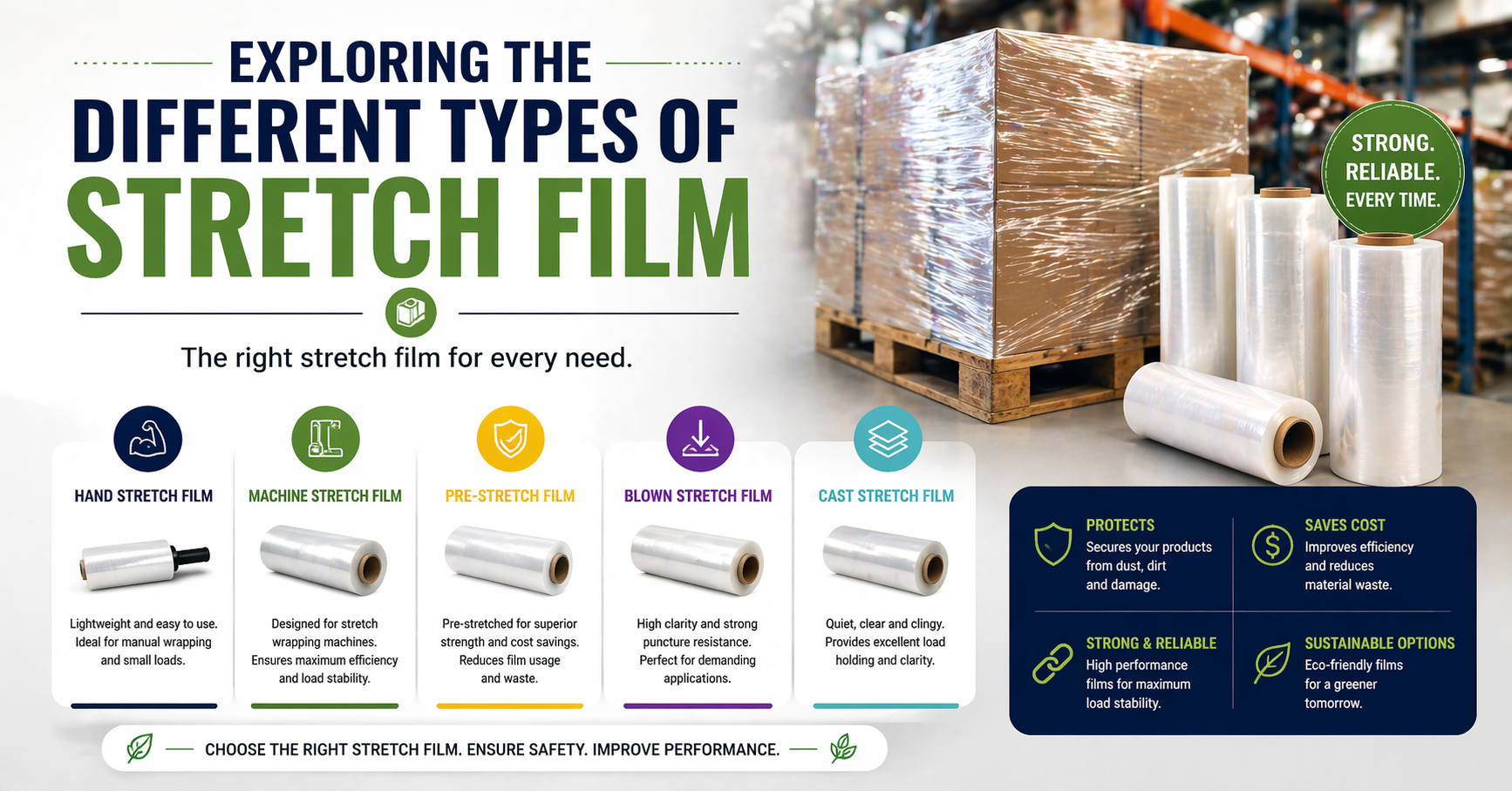
Stretch film is one of the widely used wrapping materials that is used across industries. They are cost-effective, recyclable, and protective at the same time, and minimise product loss and improve shipping efficiency.
Depending on the need, your product may require a specific type of film to enhance the packaging’s overall performance and reduce damage rates. Read this blog to explore different types of stretch film, their features, and qualities.
Before moving on, let’s clearly understand what stretch wrapping is.
What Is A Stretch Film?
A stretch film, also known as stretch wrap, is a flexible yet durable plastic film that is widely used to wrap and secure products during transportation and storage. They are primarily made from linear Low-Density Polyethene (LLPE), which offers extra stretchability and securely binds goods together. Its one highlighted feature is the self-adhesive property that clings to itself and protects the product from dust, moisture, and other damage while ensuring safe delivery.
Types Of Stretch Film
There are many types of stretch film, and choosing the right one can be stressful and time-consuming. Below you will find each type in detail, its unique properties, common uses, and advantages.
Stretch film wrap is categorised by its application method, like hand or machine, manufacturing ways such as cast or blown, and other specialised types which include pre-stretches, vented, coloured, and those with special properties like UV or VCI.
Understanding this difference will help you further to make a confident purchase decision.
By Application Method
Hand Stretch Film
A hand stretch film, also known as manual stretch film and is specifically designed for manual application. This type of pallet is usually stretched and wrapped around pallets by hand. It is one of the most common and cost-effective types and is generally used by companies that wrap a small volume of product per day, about 50 pallets.
Key Features Of Hand Stretch Film
- They are flexible and can easily adaptable to different product shapes.
- It is lightweight and easy to us that makes it ideal for small to medium-sized packaging operations.
- Its clear transparency allows easy identification.
- This film is available in a different thickness range, commonly 12-23 microns and can be customised to specific product weight and load needs.
Machine Stretch Film
They are designed to be used with automatic or semi-automatic stretch wrapping machines. These machines apply the film around the pallet with consistent tension and speed, and are primarily used to secure the loads. Its use maximises protection, minimises waste and boosts productivity and is ideal for businesses that manage large-scale shipping or warehouse operations.
Key Features Of Machine Stretch Film
- The machine offers uniform pallet wrapping and eliminates any errors.
- Compared to manual wrapping, machines wrap pallets much faster and more efficiently.
- Depending on the grade, it can stretch up to 200-300% and cover 360 area.
- They are commonly used in manufacturing, food and beverages, logistics, pharmaceuticals and the construction industry.
Pre-Stretch Film
This type of film is expanded by mechanical stretching before being wound onto rolls. The stretching process makes the film thinner, stronger and easier to use. Pre-stretched film uses less material, saves money while keeping the product secure.
Key Features Of Pre-Stretch Film
- They are ready-to-use rolls that are quick to wrap around the product manually and by machine.
- They are durable, lightweight and engineered with exceptional tensile strength.
- Suitable for a wide range of products from small to heavy industrial pallets,
Bundling Film
A bundling film is a mini stretch wrap type that securely holds smaller items together as a single unit. They are flexible, clingy and keep the small products protected from dust, dirt, or minor damage during storage and transportation without the need for tape or strapping.
Key Features Of Bundling Film
- They are durable enough to hold multiple products easily without tearing.
- It eliminates the time for extra packing like tape and straps.
- They are designed for products like boxes, pipes, tools, and bottles.
- It neatly organises the small products.
Based On The Manufacturing Process
Blown Stretch Film
A blown film wrap is produced using a blown extrusion function. This process involves molten plastic that is extruded through a circular die and then expanded into a thin tube using air.
A blown film is highly durable compared to other wraps and resistant to punctures and tears, which makes it ideal for heavy, irregular and sharp-edge loads.
Key Features Of Blown Film
- A blown wrap has a more textured surface, which provides better grip and load-holding ability.
- It has excellent memory, which helps them to tightly contract around loads after stretching to keep them secure.
- They are available in different gauges to suit light to heavy-weight products.
Cast Stretch Film
A cast stretch film refers to a wrap that us products using a cast extrusion process. A comprehensive operation where molten polymer is extruded throught a slot die onto a cooled roller to form a thin and smooth sheet.
Unlike blown stretch, this film has a glossy surface that is quite unwinding, which reduces noise which making it an ideal solution for fast-moving packaging lines.
They are often used in industries, warehouses, and retail environments where product visibility, neat presentation and efficient handling are required.
Key Features Of Cast Stretch Film
- They work as an excellent barrier property that protects the goods from dust, dirt, and contamination.
- The cling sticks tightly to itself, which keeps the load secure during transportation.
- Due to its event thickness and controlled stretch, the film waste is reduced.
Functional Stretch Films
Colour Stretch Film
As the name hints, a type of stretch film that comes in various colours such as red, black, yellow, and blue. Unlike clear wraps, these films help businesses organise, categorise, and protect pallets more efficiently with the same protection and durability.
This colour coding is ideal during the supply chain to distinguish products easily and to move them safely.
Key Features Of Colour Stretch Film
- They are available in multiple colours to support different branding needs, ranging from green, orange, and white to many more.
- This film has the same strength that wraps tightly around pallets while keeping the product stable.
- It hides the content when needed while still allowing space for labelling for branding purposes.
- These wraps provide the same protection against dust, moisture, and minor other damage.
UVI Stretch Film
A UVI stretch film, a type of stretch film that contains Ultraviolet Inhibitor (UVI) that protects the stored outdoor goods from sunlight, harmful rays, and UV damage.
These UV stabilisers are added to the film during the extrusion process, and they prevent the plastic from degrading or becoming brittle when exposed to harsh sunlight.
Key Features Of UVI Stretch Film
- They are strong and durable that holds items even under hard conditions.
- Stretch films keep time securely in place, preventing movement during shifting.
- It can be used with a machine or a hand stretch wrapper without losing performance.
VCI Stretch Film
A VCI or Vapour Corrosion inhibitors refer to a specialised form of stretch wrap that is designed to protect metal products, and it contains a special formulation that protects the metal from rust and corrosion during storage and transportation.
The VCI molecules slowly transform from film to a metal surface that offers excellent protection against oxidation even in humid and challenging environments.
Key Features Of VCI Stretch Film
- They are safe to use on a wide range of metals without causing surface damage.
- Its transparency can be controlled and coloured for inventory management.
- VCI stretch films reduce the risk of product damage or corrosion-related losses.
No-Cling Stretch Film
If you want unwanted sticking, go with no-cling stretch film, as they are designed to prevent sticking on one side, allowing you to wrap the product where needed without any clinging.
They are also ideal for items that need easy access or separation after wrapping
Key Features Of No-Cling Stretch Film
- This one-sided cling stretch film is durable and strong, which keeps the item on pallets securely.
- They are easy to handle and wrap smoothly without bunching or tearing.
- It protects the goods from dust, dirt, and other impurities.
- They are suitable for food and cosmetics, and are used when an item needs to be unwrapped individually from a bundle.
Speciality Stretch Film
A speciality stretch film refers to custom-designed film made to fulfil unique packaging needs. They are generally used for special situations where a regular wrap is not enough; they provide extra protection, stretchability, and meet compliance regulations.
Key Features Of Speciality Stretch Film
- They are an ideal option for electronics, pharmaceuticals and other delicate protect that require special protection.
- They are bespoke solutions that meet specific packaging needs and can withstand sharp edges and punctures.
- A speciality film maintains tension and keeps products tingly secured.
Netting Stretch Film
A netting stretch film features a net-like structure rather than a solid sheet and is designed to secure the product while allowing air to flow, offering excellent ventilation.
Due to its mesh surface, moisture does not usually build up and keeping delicate items safe during storage and transport.
Key Features Of Netting Stretch Film
- Netting film has a flexible application, wraps around irregular or oddly shaped objects easily.
- It can be made from recycled stock to support the eco-movement.
- They have clear visibility that allows easy inspection of the product while wrapped.
- A netting wrap is commonly used for agricultural goods or other edibles where maintaining freshness is a requirement.
Hay Baling Stretch Film
A hay baling stretch film, also known as silage stretch wrap. They are specially used for wrapping hay as they help preserve its nutritional quality by protecting it from air, moisture, and harmful light.
Hay baling wrapping has a tight seal that protects the contained item from weather and contamination during transportation.
Key Features Of Hay Baling Stretch Film
- These films withstand harsh handling and ensure the hay remains intact.
- It features a waterproof property that is helpful during rain.
- A hay baling film has excellent cling; its layers stick together firmly.
PVC Stretch Film
Also known as Polyvinyl Chloride stretch film is made from a thin layer of PVC and is highly flexible, known for its excellent cling, clarity and stretchability. They are ideal for both manual and automatic wrapping applications.
They are commonly used for packaging fresh meat, at supermarts and preserving food in the catering sector to keep edibles tightly sealed, protected and visually appealing.
Key Features Of PVC Stretch Film
- A PVC wrap stretches out easily without tearing, offering efficient wrapping.
- They perform well in a wide range of temperatures, both in cold and warm environment.
- PVC film wraps lin to itself securely, no need for extra adhesives.
Reinforced Stretch Film
Reinforces stretch film is a high-strength wrap with an extra layer of bands that provide superior stability. They are commonly used to wrap heavy, irregular, or sharp-edged pallets
This film distributes the tension evenly all around, which helps to maintain consistent holding without tearing.
Key Features Of Reinforced Stretch Film
- This film can be stretched to three times its original length without tearing or puncturing.
- These wraps are a go-to voice for companies that need high-value loads.
- Its superior strength and durability reduce film usage per pallet, which lowers overall wrapping cost.
Stretch Wrapping Equipment
In simple words, it refers to packaging devices that are used to wrap stretch film tightly around products or pallets to secure them until opened.
Thanks to the modern techniques, this mechanical equipment helps businesses save time, improve load safety and reduce waste as well. Its types are turnable, rotary arm and horizontal stretch wrappers. Read below to find out how they operate.
Turnable Stretch Wrappers
They are generally machines that wrap straight film around a pallet by spinning the pallet on a rotation platform. As the pallet moves, the film wrapper rolls around it and covers it evenly and tightly. They are easy to use, fast and reliable for securing boxes or products on pallets.
Rotary Arm Wrappers
This machine works opposite to a turntable as the pallet remains stationary and the rotating arm folds the wrap around it, applying film evenly.
They are an ideal option for heavy or unstable loads that cannot turn easily.
Horizontal Stretch Wrapper
Horizontal stretch wrappers refer to a conveyor system and are used to wrap film around long, flat, and irregularly shaped objects. For example, pipes, lumber, or large boxes.
Instead of vertical, this film is applied horizontally as the product moves on a flat belt.
Wrap Up!
To sum up all the provided information, you must have an idea of how stretch film types and their equipment are a vast field and selecting the right combination is important to your product’s success in the market. By understanding its features, the users that are provided above will help you to make an informed decision and the better match you find of type and equipment, the more confident you can be in achieving operational efficiency and customer satisfaction.